
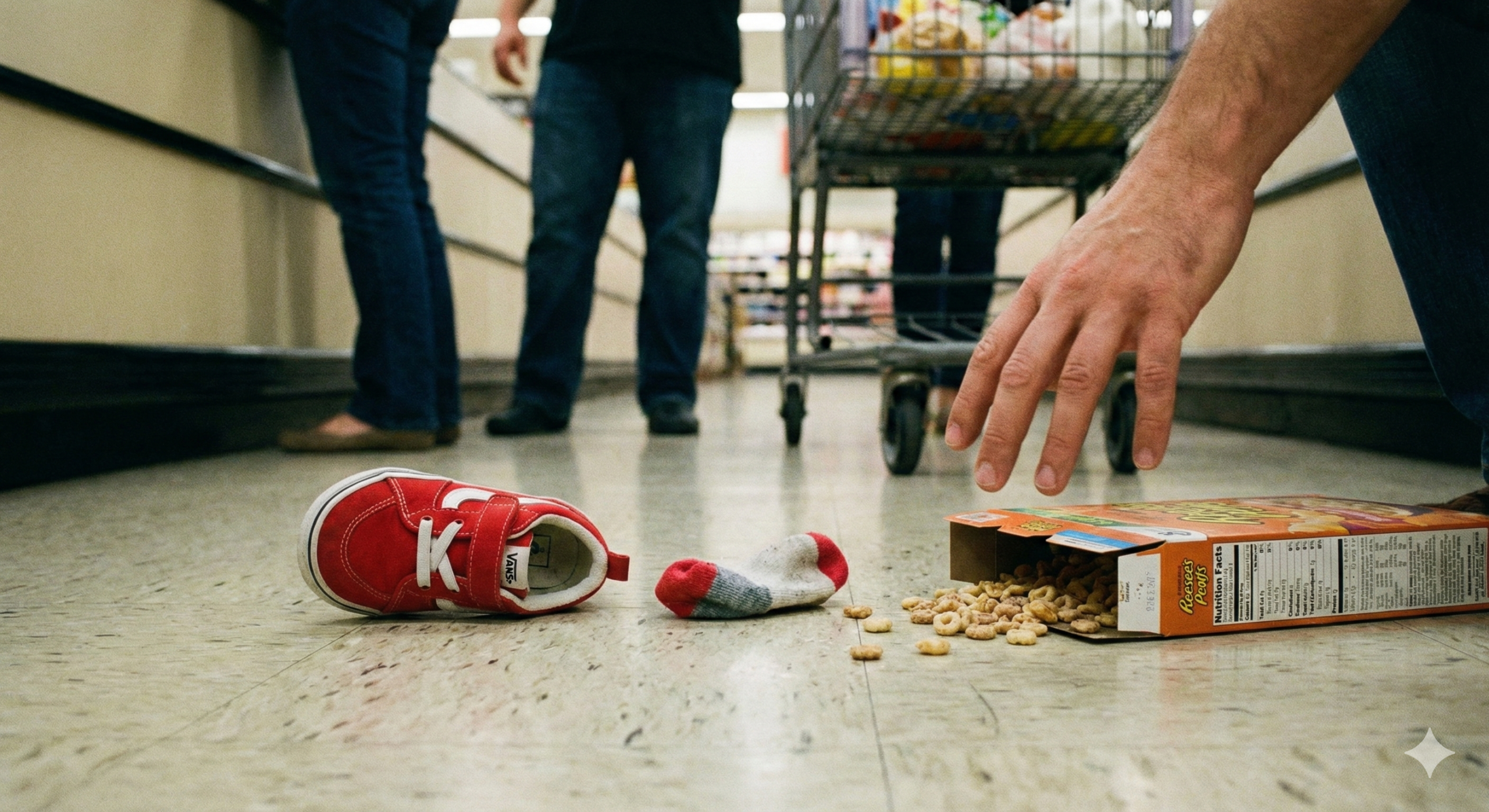

It starts subtly. A slight change in the pitch of his voice in aisle 4 because we walked past the Lego section without stopping. A tensing of his shoulders in aisle 7 because the freezer section hums at a frequency that hurts his ears.
By the time we hit the checkout line, the fuse has burned down.
It’s not a tantrum. A tantrum is “I want that candy bar.” This is a neurological short-circuit. He is on the linoleum floor, screaming at a volume that seems impossible for a small pair of lungs, kicking a display of chewing gum. He is completely unregulated. He is terrified.
And then it begins. The Stare.
You feel the atmosphere in the store shift. The older lady three carts back clutching her pearls. The guy in the baseball cap shaking his head and muttering something about “discipline.” The well-meaning but infuriating person who leans in to suggest, “Maybe he’s just tired.”
In that moment, your blood pressure hits the roof. The sweat starts. You aren’t just managing a medical event for your child; you are managing a hostile audience.
For a long time, the fear of The Stare kept us housebound. The anxiety of “What if it happens?” was worse than the event itself. It felt easier to stay home than to face the judgment of strangers who have no idea what our daily reality looks like.
But we have to buy groceries. We have to leave the house. We have to live.
I had to develop a new operating system for public outings. I had to learn how to mentally delete the audience and focus solely on the mission.
Here is the deeper dive into how I handle the public meltdown without losing my own mind.
1. Understanding the Battlefield (Why Stores Are Hell)
To handle the judgment, you first have to truly believe that your child isn’t “bad.” You have to understand the environment.
A modern grocery store or big-box retailer is essentially a sensory torture chamber for a neurodivergent brain.
- The Lights: Fluorescent lights flicker imperceptibly to us, but to them, it can look like a strobe light.
- The Sound: The beeping registers, the squeaky carts, the terrible pop music, the hum of refrigerators—it’s a cacophony that they cannot filter out.
- The Visuals: Thousands of brightly colored packages screaming for attention.
When my son hits the floor in Target, it’s not because he’s spoiled. It’s because his nervous system has taken a beating for 45 minutes and it has finally collapsed. When I truly internalized that, the opinions of strangers started to matter a lot less.
2. The Mindset Shift: Stop Performing
Before my son’s diagnosis, when a public tantrum started, my instinct was to perform “Good Parenting” for the audience.
I would use my stern voice. I would threaten consequences. I was desperately trying to signal to the other shoppers: “See? I am disciplining him. I am one of the good ones. Don’t judge me.”
I was escalating my son’s distress to appease strangers I will never see again.
The shift happened when I realized: I am not on their team. I am on his team.
When the meltdown starts, social norms go out the window. My only priority is his safety and de-escalation. If that means sitting on a dirty floor with him, I sit. If that means singing a calming song in the middle of a quiet aisle, I sing. I stopped parenting for an audience and started parenting for my kid.
3. Tactical Maneuver: Tunnel Vision and Body Blocks
When the meltdown hits level 10, the world needs to disappear. You need to create a bubble.
The Physical Shield: I immediately physically turn my back to the crowd and kneel down to his level. My body becomes a wall between him and the stares. This serves two purposes:
- It gives him a slightly smaller, safer space.
- It prevents me from making eye contact with Susan in the frozen food aisle. If I can’t see her rolling her eyes, it doesn’t exist. Ignorance is bliss.
The “Exit Strategy” (Abandon the Cart): This was the hardest hurdle for me. If the meltdown is irrecoverable, you have to be willing to abort the mission.
Yes, you spent an hour filling that cart. Yes, you need milk for tomorrow morning. It doesn’t matter. If safety is compromised, leave the cart right there in the aisle. Pick up your child (using the “football carry” under the arm if necessary to prevent kicking) and walk out. Do not look at the cashier. Do not apologize. Just get to the car.
The cart will be restocked. Your child’s trust in you as their safe person is harder to replace.
4. Scripts for the “Helpful” Stranger
Most people will just stare. But sometimes, someone is bold enough to offer unsolicited advice during the crisis. “Have you tried taking away his iPad?” or “He’s too big for that behavior.”
In the heat of the moment, I want to scream at them. But that takes energy I don’t have. You do not owe these people an education on neurodiversity. You are busy de-escalating a dumpster fire.
I use two very short scripts, depending on the situation, and I deliver them without making eye contact:
- The Deflection (For the well-meaning but annoying): Hold up a hand in a “stop” gesture and say firmly: “We are okay. Please give us space.”
- The Reality Check (For the rude ones): “This is a medical event, not a behavioral one. Back up.”
The phrase “medical event” usually shocks people into silence long enough for you to escape.
The Post-Game: The Parking Lot Shame Spiral
We talk a lot about the meltdown itself, but few dads talk about the hardest part: The five minutes after you finally get them strapped into their car seat.
The adrenaline crashes. Your hands are shaking. You can hear the blood rushing in your ears. You look back at the store and feel a wave of shame and failure wash over you. You feel like everyone in there is talking about the terrible father they just saw.
This is the most dangerous moment for your mindset.
You have to actively fight that narrative. remind yourself: You got him out safely. You didn’t lose your temper and make it worse. You prioritized his needs over your ego.
Those strangers get to go home to their quiet, predictable lives. You are in the trenches, doing the hardest job on the planet without a manual.
Let them stare. You keep moving. You’re doing a good job.