
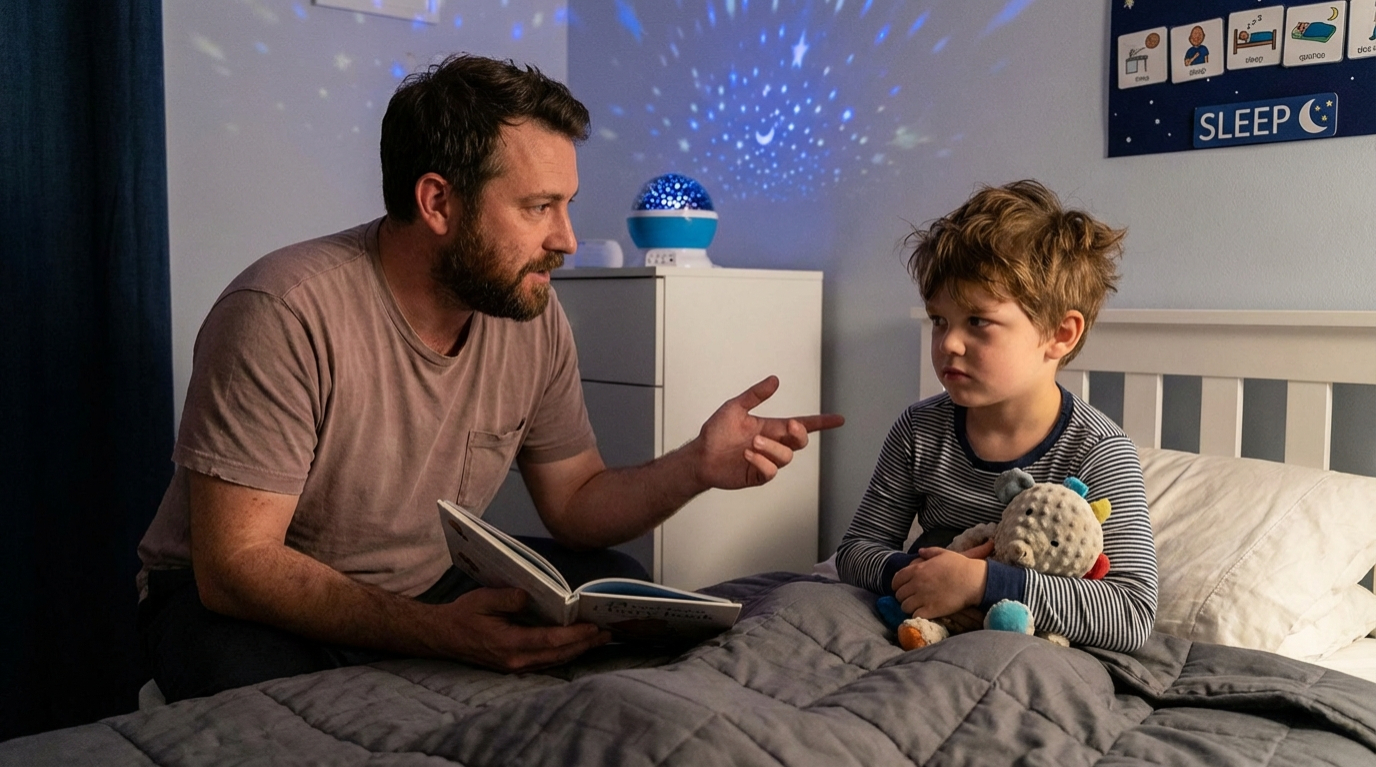

If you are reading this, there is a good chance you are tired. Not “I stayed up too late watching Netflix” tired. I mean bone-deep, three-cups-of-coffee-before-noon, parent-of-a-neurodivergent-child tired.
Sleep issues are the number one complaint I hear from other dads. And for a long time, I took it personally. I thought if I just had the right bedtime story or the stricter schedule, he would sleep.
But here is the truth I learned the hard way: Sleep is not a discipline issue. It is a sensory issue.
For many of our kids, the world doesn’t just turn off when the lights go down. Their brains are still processing the hum of the refrigerator, the texture of the sheets, and the events of the day.
Here is how we moved from “Sleepless in Ohio” to getting a decent 6-7 hours.
1. The “wind-down” starts at 4:00 PM
I used to think bedtime started at 7:30 PM. I was wrong.
If my son is jumping on the trampoline or watching high-energy YouTube videos at 5:00 PM, his cortisol (stress hormone) levels spike. It takes hours for that to leave his system.
We changed our afternoon routine to be “low sensory.” After dinner, the big lights go off. We use lamps. The volume goes down. We are signaling to his brain that the day is ending long before we actually brush our teeth.
2. The Bedroom is a “Sensory Deprivation Tank”
Most kids need a nightlight. My son needed a cave.
We realized that even the standby light on the TV or the streetlamp outside was keeping his brain online. We went tactical on his room:
- Blackout Curtains: The kind that Velcro to the wall so no light leaks in.
- White Noise: Not lullabies. Pure, flat, fan noise. It masks the random house creaks that used to wake him up.
- Compression: This was the game-changer. We use a compression sheet (it’s like a giant spandex sock for the mattress) that gives him deep pressure feedback all night.
3. The “Exit Strategy”
The hardest part for me was leaving the room. He would panic the second I stood up.
We created a visual “Exit Strategy.” I sit in a chair. Every few minutes, I move the chair a few inches closer to the door. I don’t talk. I just move. It sounds tedious, but it worked. It taught his brain that my distance didn’t mean danger.
4. Surviving the “Split Night”
Sometimes, despite all the hacks, he wakes up at 2:00 AM ready to party.
This is called a “Split Night.” It happens. When it does, do not fight it.
I used to spend two hours pleading with him to go back to sleep. We both ended up crying. Now, if he’s up, he’s up. I keep the lights off. He can look at books or play quietly in his room. I lie on the floor with a pillow.
I don’t turn on the iPad. I don’t turn on the TV. We keep it boring. Usually, within 45 minutes, the boredom wins and he drifts back off.
The Bottom Line
You aren’t a bad parent because your kid is awake. You are fighting biology.
Find the sensory triggers in the room, kill the lights, and forgive yourself for the extra cup of coffee tomorrow morning.