
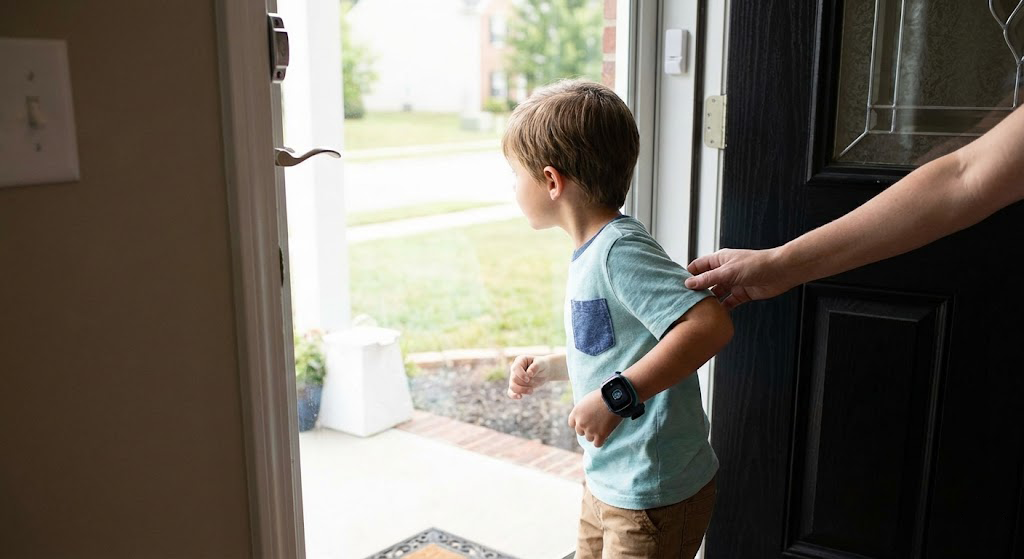

There is a specific sound that stops my heart. It’s the click of the front door opening when I know everyone is supposed to be inside.
If you are the parent of a “runner,” you know that sound. You know the instant shot of adrenaline that hits your system, the panicked sprint to the door, the desperate scan of the driveway, the street, and the nearest body of water.
For neurotypical parents, a toddler wandering off in a store is a rare, scary mistake that happens once. For us, it’s a daily, hourly reality that lasts well into childhood and sometimes adulthood.
We need to start by reframing the problem. Our kids don’t run away because they are naughty, angry, or rebellious. They run because of neurology.
The Neurology of the Bolt
Understanding why they run helps you predict when they might run. In a neurodivergent brain, the impulse to move is often stronger than any rule, any consequence, or any understanding of danger.
- Sensory Seeking (Running TOWARD something): They see water, a shiny object, a dog across the street, or a blinking traffic light. Their brain locks onto that target with intense hyperfocus. In that moment, a busy four-lane highway isn’t a threat; it’s just pavement between them and what they want.
- Sensory Avoiding (Running AWAY from something): The house gets too loud, a smell is overwhelming, or a social situation is stressful. Their fight-or-flight response kicks in, and flight wins. They aren’t running to anywhere specific; they are just frantically trying to escape the current sensory input.
- Goal-Directed Elopement: They want to go to the park. They don’t care that it’s 10 PM, raining, and three miles away. They have a goal, and they are executing a plan to get there.
Because this behavior is driven by powerful neurological impulses, you cannot simply “teach” them not to do it with sticker charts or time-outs. You cannot relying on teaching them to fear cars any more than you can teach a fish to breathe air.
So, we don’t rely on teaching alone. We rely on systems. We build redundant layers of defense that buy us the critical seconds we need to intervene before a tragedy happens.
Here is the complete, layered strategy for keeping your runner safe.
Layer 1: Fortifying the Home (The Physical Barriers)
Your home needs to be a secure perimeter. You cannot rely on “remembering to lock the door.” The system must work even when you are tired, distracted, sick, or asleep. If a lock can be opened by a determined 5-year-old, it is not a lock.
The “Hotel Lock” Rule (Exterior Doors)
A standard deadbolt is not enough. Many runners are incredibly smart and determined; they will figure out a thumb-turn deadbolt by age three or four. They will pull up chairs to reach things.
- Install High Locks: Every single exterior door needs a secondary lock installed far out of your child’s reach (at the very top of the door frame).
- The Flip Lock: Simple devices often seen in hotels that flip over to prevent the door from opening inwards. Highly effective and easy for adults to operate in an emergency.
- The Chain Lock: A classic, but ensure it’s installed high enough that they can’t use a broom handle to slide it off.
- A note on Keyed Deadbolts: Some parents switch to double-cylinder deadbolts (that require a key on the inside). Be extremely careful with this. It is a massive fire hazard. If you use one, the key must be kept on a hook right next to the door, high out of reach, so an adult can access it instantly in a fire.
Slider Doors and Windows
Sliding glass doors are notoriously easy to open.
- Charlie Bars: Use a security bar that drops into the track of the sliding door, preventing it from moving even if the lock is undone.
- Window Stoppers: Install simple clamp-on devices that only allow windows to open a few inches—enough for fresh air, but not enough for a small body to squeeze through.
- Crank Handles: If you have casement windows that crank open, remove the hand-cranks entirely and store them on a high shelf.
The Yard and Pool (Crucial Safety)
If your child gets out of the house, the yard is the next layer of defense.
- Fencing: A standard 4-foot picket fence is merely a ladder for many sensory seekers. You need high fences (6 feet+) with vertical slats that are difficult to climb. Gates must have self-closing hinges and latches placed high out of reach, preferably with a padlock.
- THE POOL DANGER: Drowning is the leading cause of death for autistic children who elope. Many are intensely drawn to water.
- Four-Sided Isolation Fencing: The pool must be completely surrounded by a fence that separates it from the house and the rest of the yard.
- Pool Alarms: Devices that float in the water and sound a shrieking alarm if the surface is disturbed by a fall.
- If you have a runner and a pool, your vigilance must be military-grade. There is no margin for error here.
Layer 2: The Alarm System (The Early Warning)
You cannot have eyes on your child 24/7. You need to sleep, shower, and cook. Technology must be your eyes and ears during those gaps.
Door and Window Chimes
Every single opening in your home should have a sensor that makes a noise loud enough to wake you from a dead sleep.
- Simple Peel-and-Stick Alarms: You don’t need an expensive ADT system. You can buy packs of inexpensive magnetic contact alarms at Home Depot. One part goes on the frame, one on the door. When the magnetic seal is broken, a loud chime or screech sounds. They are cheap, loud, and effective. Put them on every exterior door and accessible window.
- Smart Home Sensors: If you use a system like Ring, Nest, or SimpliSafe, configure the door sensors to play a loud, distinct chime on your phone and base station whenever an exterior door is opened, day or night.
The Bedroom Monitor
If your child wanders at night, you need to know the second their feet hit the floor.
- Motion Sensors in the Hall: Place a motion sensor in the hallway just outside their bedroom door. If they step out at 2 AM, you get an alert before they reach the kitchen or front door.
- Video Monitors with Alerts: A standard baby monitor isn’t enough if you are asleep. You need a camera with active motion and sound alerts that push to your phone to wake you up.
Layer 3: The Wearable Safety Net (GPS Trackers)
This is the most critical—and most complicated—layer for many families. A GPS tracker does not prevent elopement. It is a recovery tool. It is your lifeline when the worst happens.
Choosing one is overwhelming. Here is a breakdown of the reality of tracking tech.
The “Wearing War” (Keeping it On)
The best GPS in the world is useless if your child refuses to wear it or knows how to take it off. Sensory issues make this incredibly difficult.
- Locking Mechanisms: Look for devices that have specialized locking bands (requiring a magnetic key to remove) or fasteners that are difficult for little fingers to manipulate.
- Alternative Placements: If they won’t tolerate something on their wrist, look for trackers that can be clipped onto a belt loop behind their back, threaded onto shoelaces, or even sewn inside the lining of their favorite coat or pants.
Types of Trackers: Knowing the Difference
Do not assume an AirTag is enough. You need to understand the technology.
1. Dedicated Cellular GPS (Best for Most Families)
Examples: Jiobit, AngelSense, GizmoWatch.
These devices have their own cellular connection (requiring a monthly fee). They communicate directly with satellites and cell towers.
- Pros: Real-time tracking almost anywhere. Excellent geofencing (alerts when they leave a designated zone). Some offer “listen-in” features to hear their surroundings.
- Cons: Monthly cost. Battery needs daily charging.
2. Radio Frequency Tracking (For High Risk/Dense Areas)
Example: Project Lifesaver.
This is often run in partnership with local law enforcement. The child wears a bracelet that emits a specific radio frequency.
- Pros: Highly tamper-resistant bands. The signal works in dense forests, concrete buildings, or places where GPS/Cellular fails. Batteries last months.
- Cons: You cannot track them on your phone. You must call 911, and they deploy a team with tracking receivers to find the signal. It is a recovery system, not a monitoring system.
3. Bluetooth Trackers (The Backup Option)
Examples: Apple AirTag, Tile.
- Pros: Cheap, no monthly fee, battery lasts a year. Small and easy to hide.
- Cons: Do not rely on these as your primary safety device. They do not have GPS. They rely on pinging off other people’s nearby iPhones to update their location. If your child runs into a large wooded area or a deserted street where there are no other phones nearby, the tracker is useless. They are better than nothing, but they are not true safety devices.
Layer 4: Community and ID (The Village)
If your child gets out, you need other people to know who they are and that they need help.
- Medical ID Jewelry: If they won’t wear GPS, they must wear an ID bracelet or necklace. It should have their name, your phone number, and crucial info like “I have autism,” “Non-speaking,” or “Diabetes.” Get one with a locking clasp.
- Inform Your Neighbors: Swallow your pride and talk to the people on your street. Show them a picture of your child. Tell them, “My son has autism and is a runner. If you ever see him alone outside, please call me immediately and stay with him. He may not respond to his name.” Most neighbors are happy to be an extra set of eyes.
- Register with First Responders: Many local police and fire departments have a special needs registry. You provide your child’s photo, description, likely hiding spots, and triggers ahead of time so they have it on file before a crisis occurs.
Layer 5: The Crisis Plan (When It Happens)
No matter how many locks and alarms you have, there is a statistical probability that one day, a door will be left ajar, and they will be gone.
Panic will set in instantly. You need a plan written down before your brain goes offline due to fear.
The 911 Protocol:
- Do not search for 10 minutes first. If you have done a quick scan of the house and yard and they are gone, dial 911 immediately.
- State clearly: “This is a medical emergency. My child has autism and has eloped. They are missing and are at extreme risk.”
- Provide Key Intel: Tell the operator immediately: “They are drawn to water/traffic,” and “They may hide from searchers or not respond to their name.”
The “Search Profile”:
Have a document ready on your phone (and printed by the door) to hand to police immediately. It should include:
- A current, clear headshot.
- Height, weight, hair/eye color.
- Any unique identifying marks.
- Their specific fascinations (e.g., “loves construction sites,” “obsessed with ponds”).
The Bottom Line
Living with a runner is exhausting. It requires a level of hyper-vigilance that drains your soul. You feel like a prison warden in your own home.
Please hear this: It is not your fault.
You are not a bad parent because your child figured out a lock. You are not a failure because you have to use a harness in public to keep them out of traffic. You are fighting powerful biological impulses with technology and routine. It’s an incredibly hard fight.
Build your layers. Check your batteries. Lock your doors high. And try to breathe. You are doing the absolute best you can to keep them safe, and that is enough.