
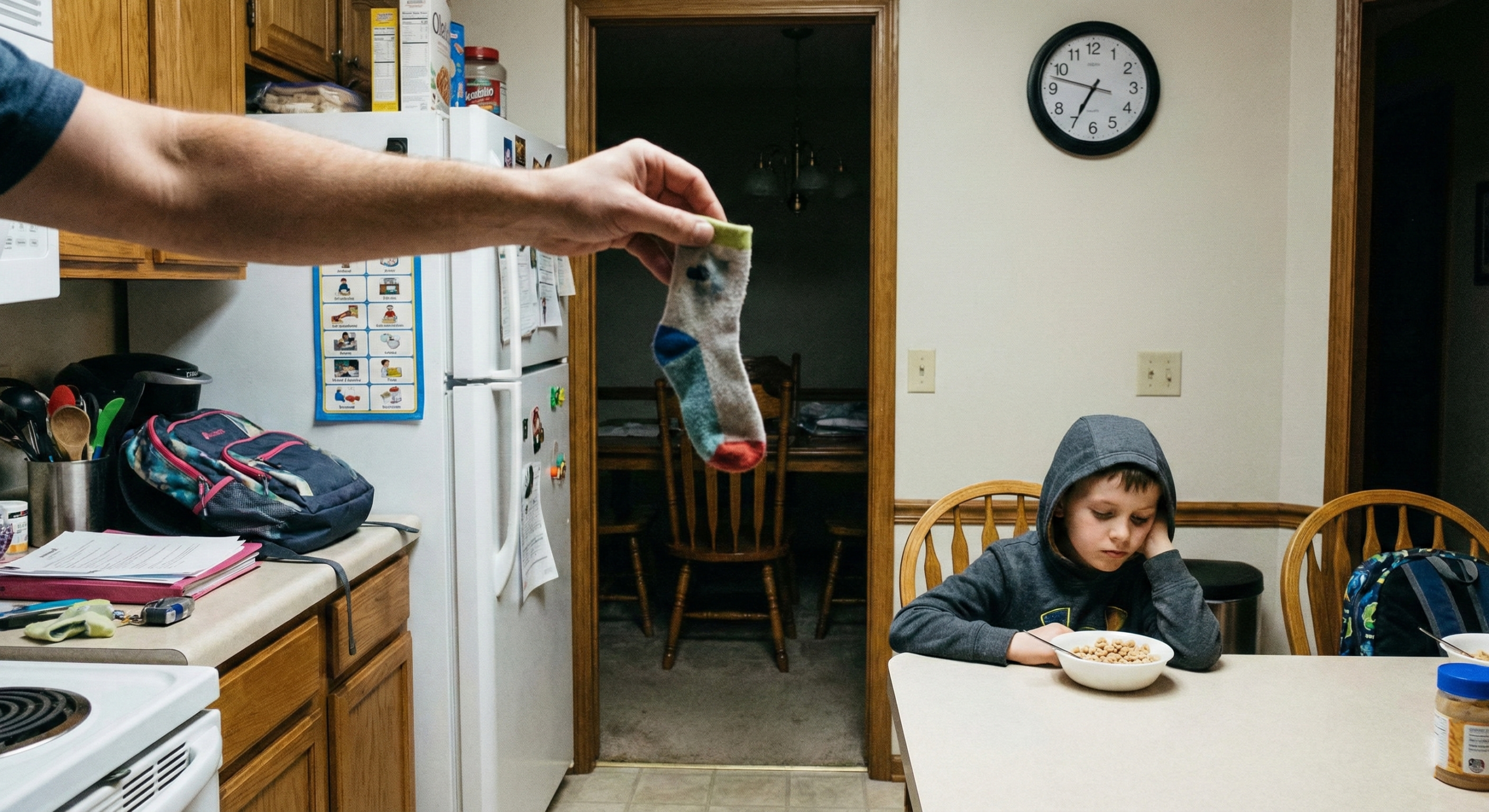

If you want to see a grown man cry, watch him try to put socks on a sensory-sensitive 6-year-old at 7:45 AM while the school bus is three minutes away.
Before my son’s diagnosis, our mornings were a daily reenactment of a hostage negotiation gone wrong. There was yelling. There were tears (often mine). There was cereal thrown. The energy in the house was pure, concentrated cortisol. By the time I dropped him off at school, I felt like I had already run a marathon, and it was only 8:30 AM.
I felt like a failure every single morning. I read the parenting books that said to use sticker charts and “firm boundaries.” I tried bribing him. I tried threatening him. None of it worked. In fact, the more pressure I applied, the more spectacular the meltdown.
It took me a long time to realize that I wasn’t dealing with a defiance problem. I was dealing with an Executive Function and Sensory Overload problem.
A neurodivergent brain often wakes up with its gears stuck cold. Transitions are physically painful. The sensory demands of getting dressed, brushing teeth, and eating breakfast under a time constraint are overwhelming. My yelling wasn’t motivating him; it was just adding more noise to an already chaotic system.
We had to tear down our entire morning routine and rebuild it from scratch, designing it specifically for his brain, not a neurotypical one.
It’s not perfect. We still have bad days. But we are no longer screaming every morning. Here is the tactical protocol that saved our sanity.
Phase 1: The Night Before (The Prep Work)
If you wait until the morning to make decisions, you have already lost.
Morning is the hardest time for executive function (planning, sequencing, decision-making). Expecting a dysregulated kid to choose an outfit or pack a bag before they’ve fully woken up is setting them up to fail.
We shifted 90% of the “thinking” work to the night before.
1. The “Approved” Outfit Choice
Clothing is our biggest sensory minefield. Seams hurt. Tags feel like sandpaper. If a shirt feels “wrong,” it can derail the entire day.
Every night before bed, we pick out the next day’s clothes together.
- The Trick: I don’t open the closet and say “What do you want to wear?” That’s too many options, leading to paralysis. Instead, I hold up two acceptable options: “Do you want the blue dinosaur shirt or the red stripe shirt?”
- The Commitment: Once he chooses, those clothes are laid out on the floor in the shape of a person. Shoes and socks are right next to them. That decision is locked in. There are no take-backs in the AM.
2. The Launchpad
We established a dedicated spot by the front door called “The Launchpad.”
Everything needed for the next day must be on the Launchpad before bedtime. Backpack packed with homework folder. Coat hung on the specific hook. Water bottle filled and sitting on the table.
If it’s not on the Launchpad at night, it doesn’t go to school in the morning. This eliminates the panicked 8:00 AM scavenger hunt for the left sneaker.
Phase 2: The Wake-Up (Soft Landings Only)
How a neurodivergent brain wakes up sets the trajectory for the entire day.
For years, I used a loud, jarring alarm clock. Or worse, I would burst into his room, flick on the overhead lights, and yell, “Time to get up!”
Imagine someone doing that to you while you were in a deep sleep. It instantly sends their nervous system into fight-or-flight mode. They wake up defensive and angry.
The Fix: Gentle Awakening. We switched to a “sunrise” alarm clock (like a Hatch Rest). It slowly brightens the room over 30 minutes, mimicking a sunrise, sometimes with gentle birdsong. It coaxes his brain awake rather than shocking it.
If I have to wake him physically, I keep the lights low, rub his back gently, and use a whisper voice. “Hey buddy, it’s morning time. I’m going to turn on the lamp now.” Soft landings only.
Phase 3: Outsourcing Executive Function
Once they are awake, the hardest part begins: moving from task to task.
“Get dressed, brush your teeth, and come downstairs” sounds like a simple instruction to us. To an ADHD or autistic brain, that is a complex, multi-step algorithm that requires holding several pieces of information in working memory simultaneously. They get stuck between steps. They get distracted by a Lego on the floor between the bedroom and the bathroom.
Then you start nagging. “Did you brush your teeth yet? Why aren’t you dressed?” The nagging increases their anxiety, making it harder for them to function.
The Fix: The Visual Schedule. We stopped giving verbal commands and started using pictures. We use a simple magnetic board with icons for every step: Toilet, Clothes, Teeth, Hair, Breakfast, Shoes.
When he gets stuck, I don’t nag. I just point to the board. “What’s next on the picture?”
- Why it works: It depersonalizes the demand. He isn’t arguing with Dad; he is arguing with the board. The board is neutral. It removes my tone of voice from the equation. It provides a concrete roadmap for his brain to follow.
Phase 4: The Sensory Minefields (Teeth and Socks)
There are two moments every morning that guarantee a meltdown in our house: brushing teeth and putting on socks.
We had to hack these tasks to make them sensory-neutral.
The Toothbrush Battle
Standard mint toothpaste burns his mouth. It feels “spicy.” Electric toothbrushes vibrate too intensely.
- The Hack: We switched to flavorless or very mild fruit-flavored toothpaste (often brands made for toddlers, even though he’s older. Who cares? Fluoride is fluoride). We use an ultra-soft manual toothbrush. It takes longer, but it gets done without tears.
The Sock Wars
The seam at the toe of a sock is the archnemesis of the neurodivergent child. If that seam is touching their pinky toe wrong, they cannot function.
- The Hack: First, buy seamless socks (they exist and they are worth every penny). Second, if you are stuck with regular socks, turn them inside out. The smooth side goes against the skin, the lumpy seam faces out. Nobody at school is checking his socks. Do whatever works.
Phase 5: The Dad Mindset (Regulate Yourself First)
This is the hardest step, and the most important one.
Our kids are barometers for our energy. If I am stressed, rushing, anxious, and raising my voice, my son will absorb that energy and amplify it back at me tenfold. A dysregulated parent cannot calm a dysregulated child.
I have to wake up before him. I need 20 minutes to drink coffee, stare at a wall, and get my own nervous system online before the chaos begins.
When things start to go off the rails—when the milk spills or the shoes suddenly “feel wrong”—my job isn’t to fix it immediately. My job is to remain the calm center of the storm. I have to actively lower my voice. I have to move slower.
If I escalate, we both lose. If I stay regulated, we have a fighting chance.
The Bottom Line
Mornings in a neurodiverse household will never be the picture-perfect, pancake-flipping scenes you see in commercials. They will always be a little loud, a little messy, and a little weird.
But by respecting their sensory needs, outsourcing the executive function to visual aids, and doing the heavy lifting the night before, you can turn the daily hostage negotiation into something resembling a routine.
Hang in there, Dad. Drink your coffee. You’ll get there.